




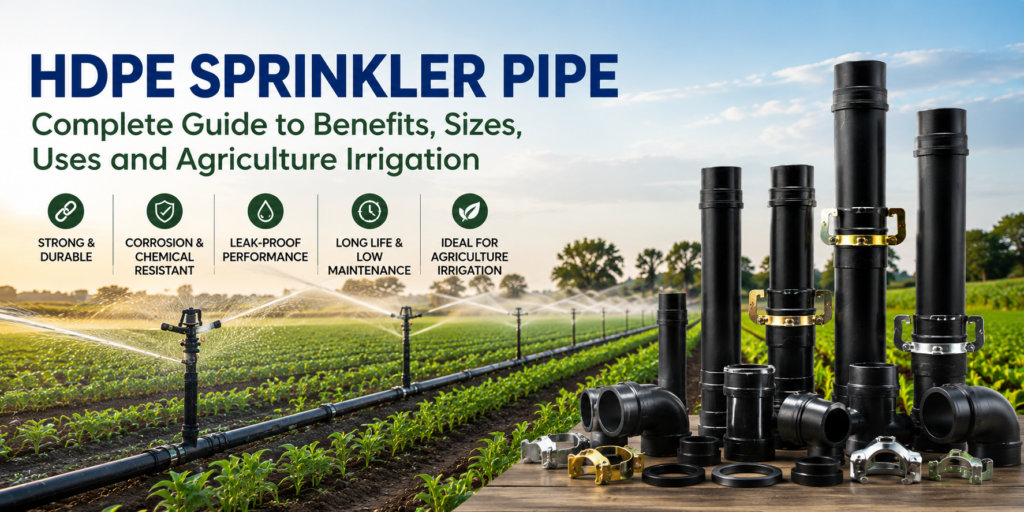
An HDPE sprinkler pipe helps farmers distribute water efficiently across agricultural fields. It carries pressurised water from a pump or main supply line to sprinkler nozzles, which spread water over crops in small droplets similar to rainfall.
Compared with uncontrolled surface irrigation, a well-planned sprinkler irrigation system can provide more uniform water distribution and help reduce surface runoff. However, its performance depends on correct pipe sizing, suitable pump pressure, sprinkler spacing, field elevation and regular maintenance.
Duke Pipes manufactures an HDPE sprinkler pipe system using High-Density Polyethylene. The system includes quick-coupling pipes, nozzles, risers, rubber sealing rings, clamps and compatible accessories for agricultural irrigation. Duke’s official sprinkler pipe range includes 40 mm to 110 mm pipes with selected pressure classes.
Quick Summary
Duke HDPE sprinkler pipes are lightweight, UV-stabilised, corrosion-resistant and designed for quick joining and field shifting. Farmers can use them for cotton, soybean, wheat, gram, groundnut, pulses, vegetables and other crops.
In addition, sprinkler systems may support industrial dust control, playground irrigation, golf-course maintenance and landscaping projects.
What Is an HDPE Sprinkler Pipe?
An HDPE sprinkler pipe is a High-Density Polyethylene pipe that carries pressurised water to sprinkler heads installed across an agricultural field.
Farmers generally connect these pipes through quick-coupling joints. Therefore, they can join, disconnect and move individual pipe sections between irrigation zones without creating a permanent pipeline layout.
A complete sprinkler irrigation system may include:
- HDPE sprinkler pipes
- Quick-coupling joints
- Sprinkler nozzles
- Risers
- Natural rubber sealing rings
- GI and KP clamps
- Bends and tees
- End caps
- Main and sub-main pipelines
- Pump and pressure-control equipment
The correct combination of pipe diameter, pump capacity, nozzle discharge and sprinkler spacing helps the system distribute water more consistently.
How Does a Sprinkler Irrigation System Work?
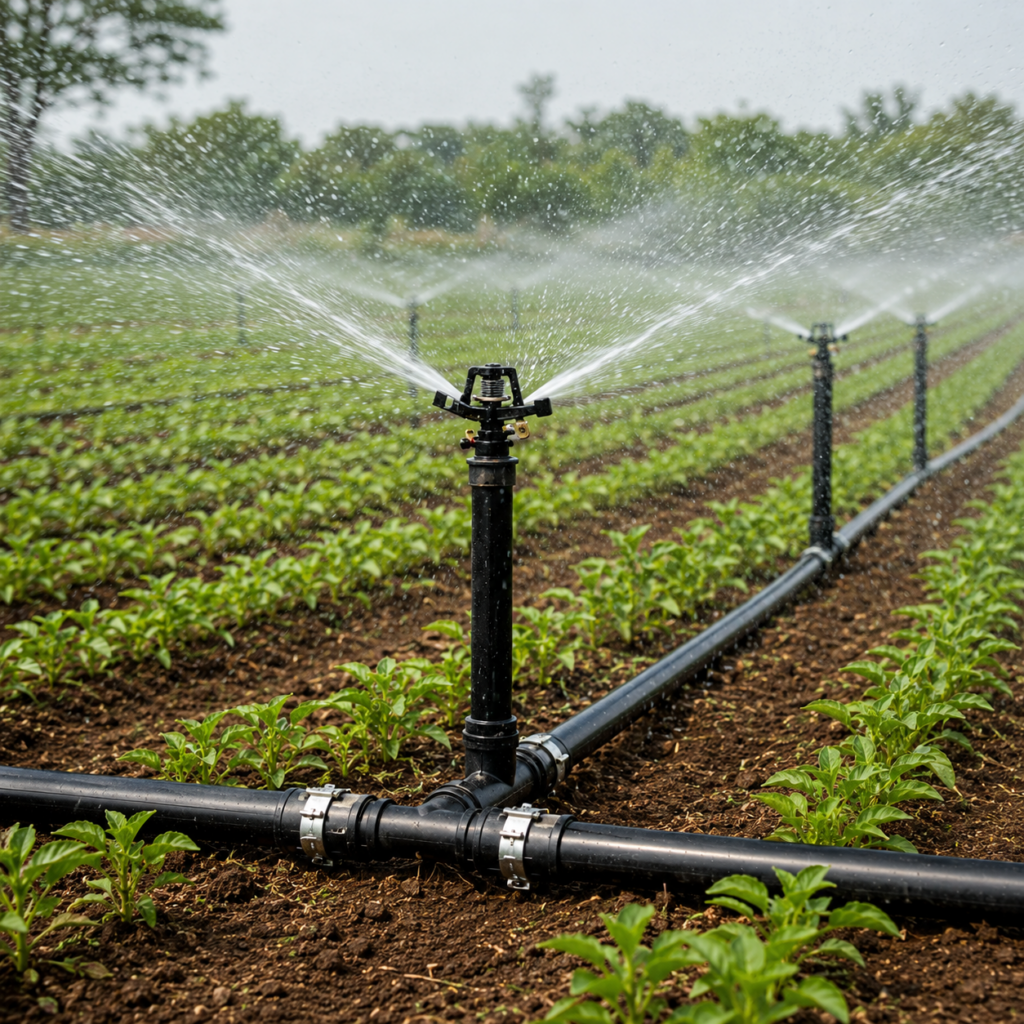
A sprinkler irrigation system moves water through a pressurised pipeline network.
First, a pump draws water from a borewell, canal, pond, reservoir or storage tank. Next, the main pipeline carries water towards the field. After that, lateral sprinkler pipes distribute the water to risers and nozzles.
Once the system reaches the required pressure, the nozzles spray water over the crops.
However, the system performs efficiently only when the pump, pipe diameter and sprinkler nozzles match one another.
Sprinkler performance depends on:
- Pump capacity
- Available water discharge
- Pipe diameter
- Pipeline length
- Operating pressure
- Sprinkler spacing
- Nozzle size
- Number of active sprinklers
- Field elevation
- Wind conditions
- Crop water requirements
A narrow pipe may create excessive friction loss. Consequently, sprinklers at the far end of the line may receive less pressure. Farmers should therefore select the pipe size according to the complete irrigation layout.
Applications of Duke HDPE Sprinkler Pipes
Duke HDPE sprinkler pipes support agricultural, industrial and landscaping applications.
Agriculture and Crop Irrigation
Farmers primarily use an agriculture sprinkler pipe for controlled crop irrigation.
The system can support crops such as:
- Cotton
- Soybean
- Wheat
- Gram
- Groundnut
- Pulses
- Maize
- Fodder crops
- Vegetables
- Other seasonal crops
A properly planned system distributes water more evenly across the crop area. Moreover, farmers may combine it with suitable fertigation practices to apply water-soluble nutrients.
Irrigation on Uneven Fields
Flood irrigation often requires proper land levelling. In contrast, sprinkler pipes can operate across uneven or undulating agricultural land.
However, changes in elevation affect water pressure. Therefore, farmers should consider the field slope while selecting pump capacity, pipe diameter and sprinkler locations.
Portable Irrigation Systems
Duke sprinkler pipes use quick-coupling connections. As a result, farmers can disconnect and move the pipes to another plot after completing one irrigation cycle.
This portability makes the system useful for seasonal crops and farms with multiple irrigation zones.
Industrial Dust Control
Industries may also use sprinkler systems to control dust in:
- Cement plants
- Mining areas
- Construction sites
- Material storage yards
- Open industrial spaces
The system sprays controlled water droplets over dusty areas. Consequently, it can help reduce airborne dust when operators use an appropriate nozzle and system layout.
Playgrounds and Golf Courses
Sprinkler pipes can support irrigation for:
- Playgrounds
- Sports fields
- Golf courses
- Gardens
- Lawns
- Landscaped areas
Other Applications
Depending on the project design, HDPE sprinkler and water-distribution systems may also support fish-rearing areas, land development and beautification projects.
What Are the Benefits of HDPE Sprinkler Pipes?
HDPE sprinkler pipes offer several practical benefits for agricultural irrigation.
Efficient Water Distribution
A properly designed sprinkler system applies water in controlled droplets across the field.
Therefore, it can reduce water accumulation in low-lying areas and improve irrigation coverage. However, actual efficiency depends on soil type, crop requirements, wind speed, operating pressure and system maintenance.
Lightweight Construction
Duke manufactures its sprinkler pipes from HDPE material to provide strength while keeping the pipes easy to handle.
Because of their lightweight construction, farmers can:
- Carry them across fields
- Load and unload them easily
- Install them quickly
- Disconnect them after irrigation
- Shift them between plots
- Store them after seasonal use
Quick-Coupling System
The quick-coupling design reduces installation time. Moreover, it allows farmers to reuse the same sprinkler pipe set in different parts of the farm.
Corrosion Resistance
HDPE does not rust like metal. Therefore, the pipe can handle regular exposure to water, soil and outdoor farming conditions.
In addition, Duke uses galvanised iron clamps in the sprinkler pipe assembly to improve rust resistance in supporting components.
UV-Stabilised Material
Agricultural pipes often remain exposed to direct sunlight. For this reason, Duke uses UV-stabilised material in its sprinkler pipe system to support outdoor performance.
Smooth Internal Surface
The smooth internal surface of an HDPE irrigation pipe helps reduce friction as water flows through it.
As a result, the system can maintain better flow efficiency across longer pipeline sections. Nevertheless, diameter, discharge, length and fittings still affect pressure loss.
Leak-Resistant Construction
Duke uses friction welding to connect the coupler-tail and pipe. This process creates a strong joint.
In addition, natural rubber sealing rings support the coupling connection and help reduce leakage during pressurised operation.
Reduced Soil Erosion
Flood irrigation can move loose soil when water flows rapidly across the field. In comparison, sprinkler irrigation applies water in smaller droplets.
Therefore, a correctly adjusted sprinkler system can help reduce surface runoff and soil erosion.
Suitable for Different Crop Cycles
Farmers can use HDPE sprinkler pipes for:
- Seasonal crops
- Permanent plantations
- Vegetable farming
- Nursery irrigation
- Rotational farming
- Temporary irrigation layouts
Salient Features of Duke HDPE Sprinkler Pipes
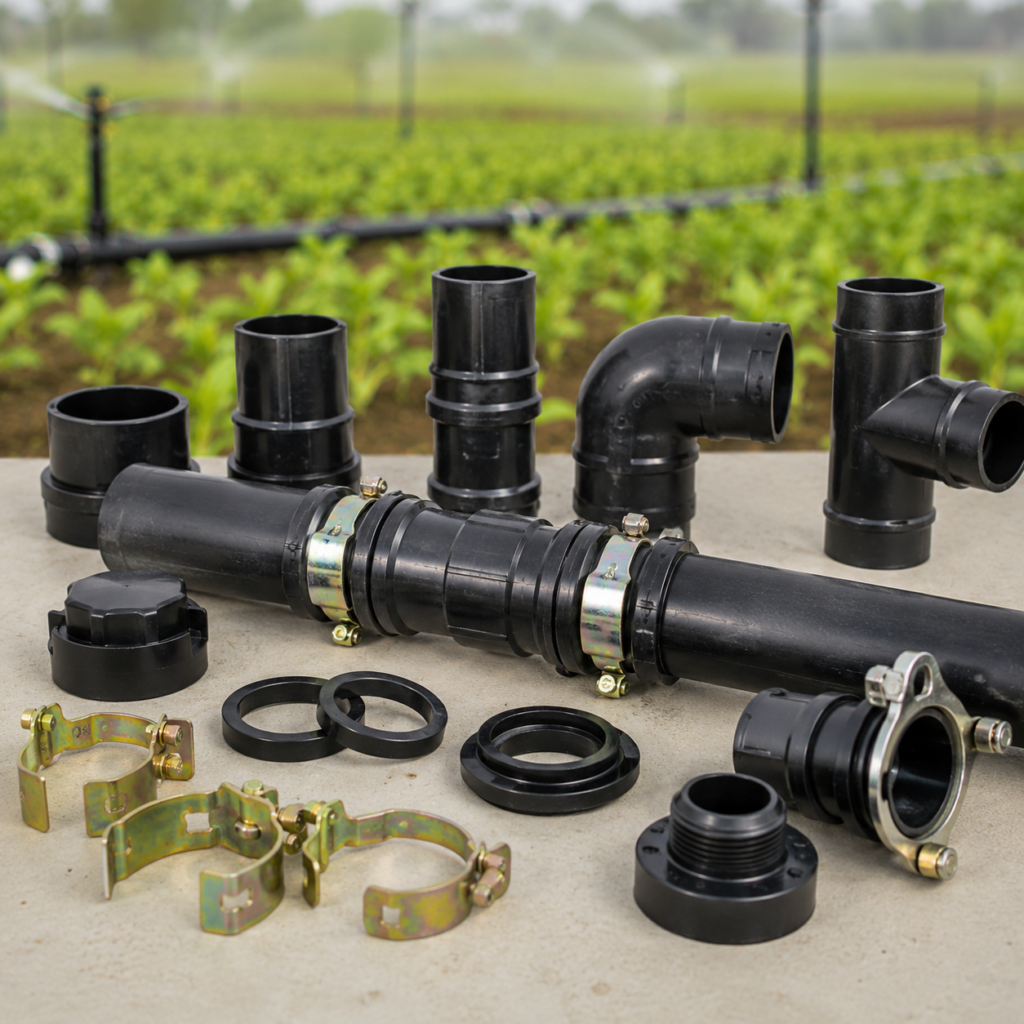
Duke sprinkler pipes include several product-specific design features.
Anti-Rust GI Clamps
Duke uses galvanised iron clamps in its sprinkler pipe system.
Galvanisation improves rust resistance. Therefore, the clamps can handle regular exposure to moisture better than ordinary untreated iron components.
Rubber Bushings in KP Clamps
Rubber bushings surround the screws in KP clamps. As a result, they help reduce direct exposure to moisture and protect the connection.
Double-Lock Coupling
Duke uses double-collared natural rubber rings inside the couplers.
This design creates a double-lock arrangement between the coupler and tail joint. Consequently, the connection remains secure during normal pressurised operation.
Friction-Welded Joints
Duke joins the coupler-tail and pipe through friction welding.
Unlike temporary fastening methods, this process creates a permanent joint and helps reduce leakage at the connection.
Lightweight HDPE Material
HDPE material supports consistent pipe quality and pressure performance while keeping the pipes easy to carry.
Shock Resistance
HDPE offers greater flexibility than many rigid piping materials. Therefore, it can tolerate regular handling and minor field impacts.
However, farmers should still protect pipes from sharp stones, heavy vehicles and incorrect storage.
Common HDPE Sprinkler Pipe Sizes
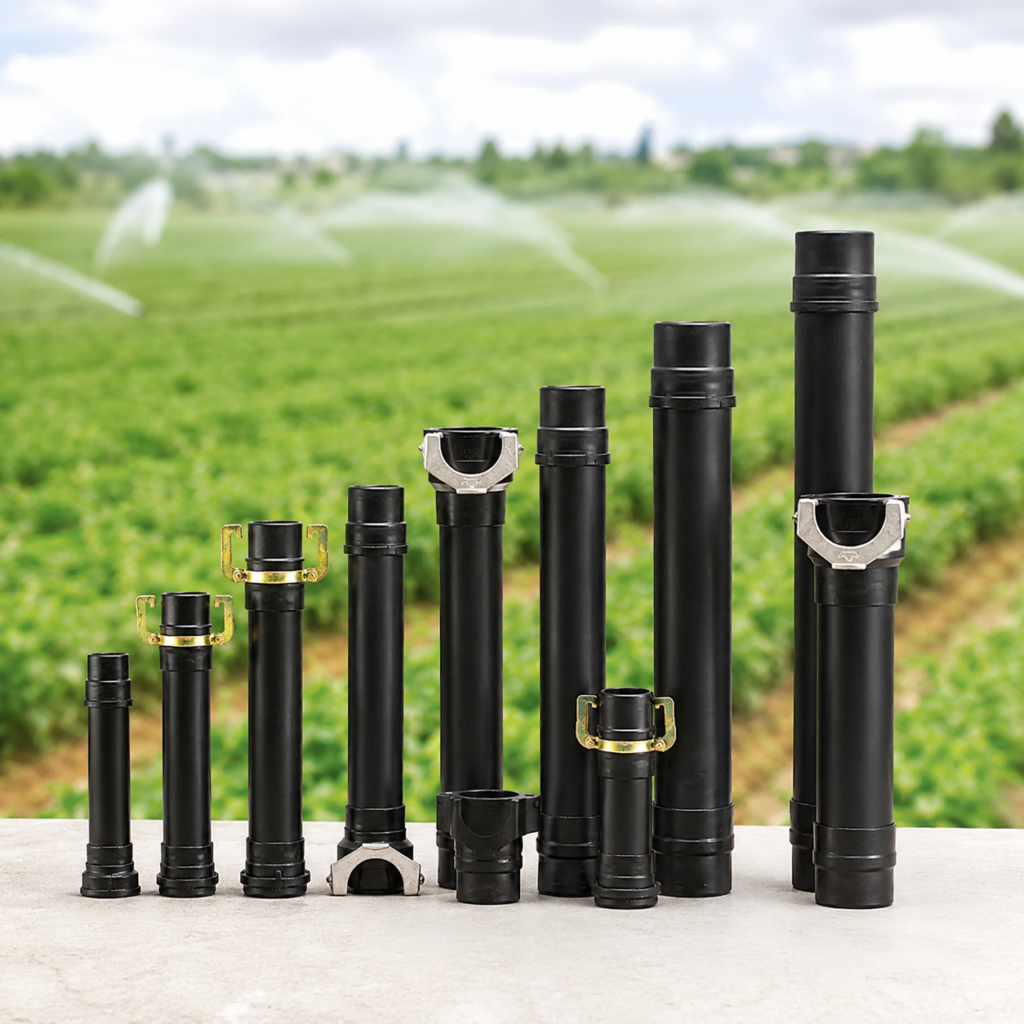
Duke’s official sprinkler pipe range includes the following nominal diameters and effective lengths:
| Nominal Diameter | Approximate Inch Size | Effective Length | General Application |
|---|---|---|---|
| 40 mm | 1.5 inch | 6 metres | Small irrigation sections |
| 50 mm | 2 inch | 6 metres | Small to medium layouts |
| 63 mm | 2.25 inch | 6 metres | Portable sprinkler systems |
| 75 mm | 2.5 inch | 6 metres | Medium-flow distribution |
| 90 mm | 3 inch | 6 metres | Larger irrigation networks |
| 110 mm | 4 inch | 6 metres | Higher-flow or sub-main lines |
These applications offer general guidance. Therefore, farmers should select the final size according to pump capacity, flow rate, pipeline length, field elevation and the number of operating sprinklers.
63 mm HDPE Sprinkler Pipe
A 63 mm or approximately 2.25-inch sprinkler pipe may suit portable agricultural irrigation layouts.
It offers a balance between flow capacity and ease of movement.
75 mm or 2.5-Inch Sprinkler Pipe
A 75 mm or 2.5-inch HDPE sprinkler pipe can support lateral or distribution lines that require moderate water flow.
Therefore, farmers may consider it for medium-sized sprinkler layouts.
110 mm or 4-Inch HDPE Pipe
A 110 mm or 4-inch HDPE pipe can support higher-flow distribution or sub-main lines.
For example, it may suit larger farms where the irrigation system must carry more water across longer distances.
6-Inch HDPE Main Supply Pipe
A 6-inch HDPE pipe may serve as a main water-supply line in large farms or high-discharge irrigation networks.
However, this size generally belongs to the standard HDPE pipe range rather than Duke’s quick-coupling sprinkler pipe range. For larger projects, farmers can use HDPE pipes for water supply to carry water from the source to the sprinkler distribution network. Duke lists its general HDPE pipes for water supply, agriculture, borewell and industrial applications.
How Should Farmers Choose the Correct Sprinkler Pipe Size?
Farmers should not select sprinkler pipe size only according to total farm area.
Instead, they should consider the complete hydraulic requirement.
Water Flow Requirement
First, calculate the total discharge required by all sprinklers operating at the same time.
For example, a system with ten active sprinklers needs more flow than a system with two sprinklers. Therefore, the pipeline must carry the combined discharge.
Pump Capacity
The pump must provide enough pressure and water for the complete sprinkler system.
However, a larger pipe cannot correct the limitations of an undersized pump. Therefore, farmers should verify pump discharge before choosing the pipe diameter.
Pipeline Length
Pressure gradually decreases as water moves through a pipeline.
Longer pipelines usually create more friction loss. Consequently, they may require a larger diameter or a different field layout.
Number of Sprinklers
Each sprinkler requires a particular flow rate and operating pressure.
Therefore, farmers should calculate the total water demand of all sprinklers that will operate together.
Field Elevation
Water pressure decreases when a pipeline moves uphill and increases when it moves downhill.
Consequently, farmers must consider field elevation during irrigation planning.
Pressure Class
The selected pipe must handle normal operating pressure and possible pressure surges.
For this reason, farmers should not select a pressure class below the calculated system requirement.
Nozzle Size
Larger sprinkler nozzles generally need a higher discharge.
Therefore, nozzle size affects pipe diameter, pump capacity and sprinkler spacing.
HDPE Sprinkler Pipe Pressure Classes
Duke sprinkler pipes are available in selected pressure classes, depending on diameter:
- 0.25 MPa
- 0.32 MPa
- 0.40 MPa
- 0.60 MPa
Not every pipe diameter is available in every pressure class. Therefore, buyers should confirm the technical chart for the required size before ordering.
The correct pressure class depends on:
- Pump output
- Field elevation
- Pipeline length
- Number of sprinkler heads
- Required nozzle pressure
- Valve operation
- Possible pressure surges
How Should Farmers Install HDPE Sprinkler Pipes?
Farmers can improve system performance by following a planned installation process.
- First, prepare the irrigation layout.
- Next, confirm pump discharge and operating pressure.
- Select the correct pipe diameter and pressure class.
- Keep the pipe route as straight as practical.
- Clean each coupling before joining the pipes.
- Inspect rubber seals for cuts or deformation.
- Avoid dragging pipes over sharp stones.
- Position sprinkler risers at the planned spacing.
- Open valves gradually to avoid sudden pressure surges.
- Check every joint for leakage.
- Measure pressure at the first and last sprinkler.
- Finally, keep pipelines away from tractors and heavy vehicles.
Before regular use, farmers should test the complete system at controlled pressure.
How Should Farmers Maintain HDPE Irrigation Pipes?
Regular maintenance helps prevent leakage, pressure loss and uneven sprinkler performance.
Farmers should inspect:
- Pipe surfaces
- Coupling joints
- Natural rubber sealing rings
- GI clamps
- KP clamp screws
- Sprinkler nozzles
- Risers
- End caps
- Pump pressure
- Water filters
For example, dirt inside a nozzle can reduce discharge and create uneven irrigation coverage. Therefore, farmers should clean blocked nozzles carefully.
Moreover, they should replace damaged rubber seals instead of relying on temporary repairs. Otherwise, a worn seal may continue leaking and reduce pressure across the line.
After seasonal use:
- Drain the remaining water
- Clean soil from every coupling
- Store rubber rings safely
- Keep pipes away from sharp tools
- Avoid placing heavy materials over pipes
- Arrange pipe sections in an organised stack
What Affects HDPE Sprinkler Pipe Price?
The HDPE sprinkler pipe price depends on the technical specification and total project requirement.
Important price factors include:
- Pipe diameter
- Pressure class
- Wall thickness
- Effective pipe length
- Raw material quality
- Number of pipe sections
- Coupling type
- Required fittings
- Sprinkler nozzles
- Risers
- Order quantity
- Delivery location
Therefore, farmers should compare the complete system specifications instead of checking only the cost of one pipe.
A complete sprinkler pipe set may include:
- Quick-coupling pipes
- Sprinkler nozzles
- Risers
- Bends
- Tees
- End caps
- Rubber sealing rings
- Clamps
- Other irrigation accessories
For current size availability, sprinkler pipe prices and project quotations, contact Duke Pipes for pricing.
Phone: +91 73920 73920
Alternate numbers: 02742-280023/24
Email: [email protected]
Duke Pipes is based near Palanpur, Gujarat, and lists these details on its official contact page.
HDPE Sprinkler Pipe vs Flood Irrigation
| Factor | Sprinkler Irrigation | Flood Irrigation |
|---|---|---|
| Water distribution | Nozzles distribute controlled droplets | Water flows over the soil |
| Land levelling | Can operate on uneven land with proper planning | Generally needs suitable levelling |
| Portability | Quick-coupling pipes can be shifted | Channels usually remain fixed |
| Soil erosion | Controlled spray may reduce runoff | Fast flow may move soil |
| Pump requirement | Requires suitable operating pressure | May use gravity flow |
| Wind effect | Wind can affect spray distribution | Wind has less effect |
| Initial setup | Requires pipes, pump and nozzles | Requires channels or field borders |
| Uniformity | Depends on pressure and spacing | Depends on slope and levelling |
Sprinkler irrigation does not automatically suit every farm. Therefore, farmers should consider crop type, soil, available water, wind conditions, pump cost and local farming practices before choosing a system.
Why Choose Duke HDPE Sprinkler Pipes?
Duke HDPE sprinkler pipes include several practical features:
- Quick-coupling system for field shifting
- UV-stabilised HDPE material
- Corrosion-resistant pipe construction
- Galvanised supporting clamps
- Double-lock natural rubber rings
- Friction-welded coupler joints
- Smooth internal surface
- Lightweight construction
- Multiple pipe diameters
- Selected pressure classes
- Compatible fittings and accessories
- Agriculture and industrial applications
Duke Pipes states that it has manufactured uPVC and HDPE piping products since 1998 from its facility near Palanpur, Gujarat.
Frequently Asked Questions
What is an HDPE sprinkler pipe?
An HDPE sprinkler pipe is a High-Density Polyethylene pipe that carries pressurised water to sprinkler nozzles in an agricultural irrigation system.
What are the main benefits of an HDPE sprinkler pipe?
It is lightweight, corrosion-resistant, flexible and easy to shift. In addition, its smooth internal surface helps support efficient water flow.
Which pipe is best for sprinkler irrigation?
The best sprinkler pipe has the correct diameter, pressure class, flow capacity and fittings for the farm’s pump and irrigation layout.
What crops can farmers irrigate with sprinkler pipes?
Farmers can use sprinkler pipes for cotton, soybean, wheat, gram, groundnut, pulses, maize, vegetables and several other crops.
Which sprinkler pipe sizes does Duke offer?
Duke’s official sprinkler pipe range includes 40 mm, 50 mm, 63 mm, 75 mm, 90 mm and 110 mm diameters.
Can farmers use HDPE sprinkler pipes on uneven land?
Yes. However, they must consider pressure changes caused by field elevation while planning the system.
Does an HDPE sprinkler pipe rust?
HDPE pipe material does not rust like metal. Duke also uses galvanised components to improve rust resistance in the supporting assembly.
How does a quick-coupling system help farmers?
It allows farmers to join, disconnect and shift pipe sections between different fields with less installation effort.
What affects the HDPE sprinkler pipe price?
Pipe diameter, pressure class, wall thickness, couplings, fittings, nozzles, quantity and delivery location affect the final price.
Can industries use sprinkler pipes?
Yes. Industries may use sprinkler systems for dust-control applications in cement plants, mining areas, construction zones and open storage locations.
How can farmers prevent sprinkler pipe leakage?
Farmers should clean the couplings, inspect rubber rings, use compatible fittings and operate the system within the recommended pressure range.
Conclusion
An HDPE sprinkler pipe provides a practical method of distributing water across agricultural fields through a pressurised irrigation system.
Its lightweight construction, corrosion resistance, smooth internal surface and quick-coupling design make it suitable for portable and seasonal irrigation.
Moreover, farmers can combine Duke sprinkler pipes with nozzles, risers, fittings and larger HDPE main lines to create a complete irrigation network.
However, farmers should not choose a pipe only according to price or diameter. Instead, they should consider:
- Pump capacity
- Water discharge
- Pipeline length
- Field elevation
- Number of sprinklers
- Nozzle size
- Operating pressure
- Crop water requirements
Ultimately, a properly selected and maintained sprinkler irrigation system can improve water distribution, control surface runoff and make irrigation easier to manage.