





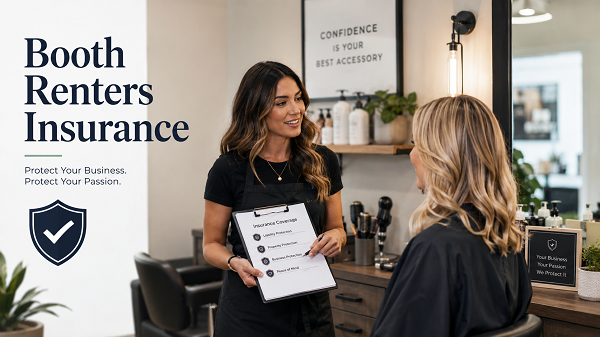
Working as a booth renter gives you more control over your schedule, prices, clients, and services. But it also means that you may be responsible for your own business risks.
A salon owner may have insurance for the building and salon business, but that policy may not automatically protect an independent hairstylist, barber, nail technician, esthetician, or cosmetologist.
That is why many independent beauty professionals purchase booth renters insurance. It can help protect you if a client gets injured, claims that your service caused harm, or if your business tools are damaged or stolen.
This guide explains booth rental insurance coverage, costs, requirements, benefits, exclusions, and the responsibilities of booth renters and salon owners.
What Is Booth Renters Insurance?
Booth renters insurance is business insurance for independent beauty and wellness professionals who rent a chair, booth, room, or salon suite.
It is commonly purchased by:
- Hairstylists
- Barbers
- Nail technicians
- Estheticians
- Makeup artists
- Lash and brow technicians
- Massage therapists
- Cosmetologists
- Mobile beauty professionals
- Salon suite renters
The policy may also be called:
- Booth rental insurance
- Salon booth rental insurance
- Booth insurance
- Hair stylist insurance
- Cosmetology insurance
- Independent contractor salon insurance
A typical policy may combine general liability and professional liability coverage. Optional protection may be available for tools, equipment, supplies, products, cyber risks, and business interruptions.
The U.S. Small Business Administration explains that business insurance can help protect a company from unexpected costs caused by accidents, property damage, lawsuits, and other losses. It also notes that an LLC offers limited protection and does not replace suitable business insurance.
How Does a Salon Booth Rental Work?
In a booth rental arrangement, a beauty professional pays the salon owner to use a chair, station, room, or private suite.
A genuine independent booth renter may:
- Set their own schedule
- Choose their own prices
- Manage their own clients
- Collect payments directly
- Buy their own supplies
- Provide their own tools
- Market their own services
- Carry their own business license and insurance
- Pay their own business expenses and taxes
However, a written contract or Form 1099 does not automatically make someone an independent contractor.
The IRS looks at several facts, including behavioral control, financial control, and the type of relationship between the business and the worker. All relevant facts must be considered.
Federal and state worker-classification rules can also change. Salon owners and renters should review current federal and state guidance when the working relationship is unclear.
Are Booth Renters Provided Insurance by the Salon?
Many professionals ask, “Are booth renters provided insurance by the salon?”
Usually, coverage is not automatic.
A salon may carry beauty salon insurance, but that policy is mainly designed for the salon owner’s business. It may cover the building, common areas, salon property, employees, or services performed by the salon itself.
It may not cover:
- Your professional mistakes
- Your services and treatments
- Your business tools
- Products you sell
- Your client records
- Your employees or assistants
- Claims made directly against your business
Before starting work, ask the salon owner whether you are included in the salon’s policy. Do not rely only on a verbal promise. Request written confirmation from the insurance company or agent.
When coverage is not clearly confirmed, you should consider buying separate insurance for salon booth renters.
What Does Booth Renters Insurance Cover?
Coverage depends on the policy, insurer, services, and selected limits. The following protections are commonly available.
| Coverage | What it may protect |
|---|---|
| General liability | Client injuries and accidental property damage |
| Professional liability | Claims connected to your professional services |
| Product liability | Injuries or reactions caused by products |
| Tools and equipment | Business property damaged or stolen in a covered event |
| Business interruption | Lost income after certain covered closures |
| Cyber liability | Client data, booking systems, and payment information |
| Workers’ compensation | Work-related employee injuries where required |
General Liability Insurance for Salon Booth Renters
General liability insurance for salon booth renters helps with certain third-party injury and property-damage claims.
For example, it may help if:
- A client slips near your station
- Someone trips over your equipment cord
- Hair color damages a client’s clothing
- You accidentally damage salon property
- A visitor is injured by an item in your work area
For a covered claim, the policy may help pay eligible medical costs, legal-defense expenses, settlements, or judgments, subject to policy limits and exclusions.
This coverage is also commonly called liability insurance for salon booth renters.
Professional Liability Insurance for Booth Renters
Professional liability insurance for booth renters helps protect against claims connected to your services, advice, or professional mistakes.
It may apply when a client claims that your work caused:
- A chemical burn
- Hair or scalp damage
- Skin irritation
- An allergic reaction
- Nail damage
- An infection
- An injury during treatment
- Another form of professional harm
For example, a client may claim that a hair-color treatment damaged their scalp. General liability may not address the professional-service part of that claim, but professional liability may provide protection if the service is covered.
Because beauty professionals work directly with clients, both general and professional liability coverage are important to consider.
Product Liability Coverage
Product liability may help when a product you sold, recommended, or used causes an injury or reaction.
Covered products may include:
- Hair color
- Shampoo and conditioner
- Skin-care products
- Waxing products
- Nail products
- Makeup
- Lash adhesive
- Oils and lotions
Not every policy includes product liability automatically. Check whether it is included or must be added separately.
Tools and Equipment Coverage
Beauty professionals often invest a large amount of money in business tools.
These may include:
- Hair dryers
- Flat irons
- Curling tools
- Clippers and trimmers
- Nail lamps
- Nail drills
- Facial machines
- Massage tables
- Tablets
- Card-payment devices
- Product inventory
Tools and equipment coverage may help repair or replace covered business property after theft, fire, or another insured event.
Ask whether your policy uses:
- Replacement cost: Helps replace an item with a comparable new item.
- Actual cash value: Usually reduces payment for age and depreciation.
You should also check whether tools are covered when kept in your vehicle, used at events, or taken to clients’ homes.
Business Interruption Coverage
Business interruption coverage may help replace some lost income when a covered event temporarily stops you from working.
For example, it may apply if a covered fire damages the salon and you cannot use your rented booth for several weeks.
It does not cover every type of closure. The event that caused the interruption must normally be covered by the policy.
Cyber Liability Coverage
Many booth renters use online booking systems, digital payments, and electronic client records.
Cyber liability may help with certain costs caused by:
- Stolen client information
- Hacked booking software
- Payment-data exposure
- Cyber extortion
- Client notification
- Data recovery
This coverage may be useful when you store private client or payment information.
Workers’ Compensation Insurance
Workers’ compensation may help cover employee medical expenses and lost wages after a work-related injury.
A booth renter who works alone may have different requirements from someone who hires assistants or employees. Rules vary by state and business structure.
Before hiring anyone, check current requirements with your state labor agency, insurance department, or a licensed insurance professional.
What Is Usually Not Covered?
Even strong salon booth rental insurance does not cover every event.
Common exclusions may include:
- Intentional injury or damage
- Illegal services
- Services performed without a required license
- Treatments not listed in the policy
- Normal wear and tear
- Incidents that happened before the policy began
- Claims above the policy limits
- Flood or earthquake damage without added coverage
- Employee injuries without required workers’ compensation
- Personal belongings unrelated to the business
- Work performed at an unlisted location
- Certain high-risk beauty or medical treatments
Some policies may exclude permanent makeup, microblading, laser services, body piercing, injectables, or advanced medical esthetic procedures unless they are specifically approved.
Always give the insurer a complete and accurate list of your services.
How Much Does Booth Renters Insurance Cost?
The cost of booth insurance varies by insurer, state, services, limits, and optional coverage.
As of July 2026, some specialist beauty insurers advertise basic booth-renter liability plans starting at approximately $96 per year or $9.99 per month. Another beauty-industry provider advertises a plan at $179 per year. These are starting prices from individual providers, not guaranteed national averages. Actual quotes can be higher depending on your risk and chosen coverage.
Your price may be affected by:
- Your profession
- State and city
- Services provided
- Annual revenue
- Number of clients
- Claims history
- Policy limits
- Deductible
- Value of tools and supplies
- Products sold
- Number of locations
- Mobile services
- Employees or assistants
- Optional coverages
A hairstylist who only cuts and styles hair may pay a different amount from someone offering chemical peels, permanent makeup, or other higher-risk services.
Compare the full coverage instead of choosing a plan only because it has the lowest price.
What Benefits Does Booth Rental Insurance Provide?
Financial Protection
A single injury or professional-liability claim may result in medical costs, legal expenses, or a settlement. Insurance can reduce the amount you may need to pay personally for a covered claim.
Protection for Your Services
Clients may claim that a treatment caused hair, skin, nail, or scalp damage. Professional liability can help protect your business against covered service-related claims.
Protection for Business Tools
Property coverage may help repair or replace tools after a covered loss.
Rental Agreement Compliance
Some salon owners require renters to provide proof of liability coverage before allowing them to work.
Greater Business Credibility
Carrying hair stylist insurance or cosmetology insurance shows that you are treating your work as a professional business.
Business Recovery
Property and interruption coverage may help you return to work after certain covered events.
Salon Owner Responsibilities to Booth Renters
The exact salon owner responsibilities to booth renters depend on the rental contract, state law, building lease, and worker relationship.
Common responsibilities may include:
- Providing a clear written rental agreement
- Explaining rent, fees, and payment terms
- Identifying the renter’s work area
- Explaining which common facilities may be used
- Maintaining common areas in a reasonably safe condition
- Clearly stating insurance requirements
- Explaining responsibility for repairs and utilities
- Maintaining insurance for the salon owner’s own business
- Following applicable licensing and workplace rules
- Correctly classifying workers
Salon owners should avoid assuming that a worker is an independent contractor only because a contract uses that term. The real working relationship and level of control also matter under IRS guidance.
State laws may set different requirements, so salon owners should seek qualified legal or tax advice when necessary.
Booth Renters Insurance vs. Beauty Salon Insurance
These policies protect different businesses.
Beauty Salon Insurance
Beauty salon insurance is normally purchased by the salon owner. It may cover:
- Salon-owned property
- Common areas
- Employees
- The salon’s services
- Salon furniture
- Building-related risks
- The salon owner’s liability
Booth Renters Insurance
Booth renters insurance is normally purchased by an independent beauty professional. It may cover:
- The renter’s professional services
- General liability claims
- Professional liability claims
- Products used or sold
- Tools and equipment
- Mobile services
- The renter’s separate business activity
A salon owner and an independent renter may both need separate policies.
What Is a Certificate of Insurance?
A Certificate of Insurance, or COI, is a document that shows basic information about your active policy.
It normally includes:
- Your name or business name
- Insurance company
- Policy dates
- Coverage types
- Coverage limits
- Certificate holder
- Additional-insured information, when applicable
A salon owner may ask for a COI before you begin work.
A certificate holder receives evidence that the policy exists. An additional insured may receive limited protection under the policy for certain claims connected to your work.
Being listed as an additional insured does not provide protection for every possible claim.
How to Choose Insurance for Salon Booth Renters
1. Read Your Rental Agreement
Check whether the salon requires specific policies, limits, or additional-insured status.
2. List Every Service You Provide
Include regular services, occasional treatments, mobile work, and special events.
3. Calculate the Value of Your Equipment
Add the replacement cost of your tools, electronics, supplies, furniture, and inventory.
4. Compare General and Professional Liability
Do not assume one type of liability coverage protects you from every claim.
5. Review All Exclusions
Look closely at rules for chemicals, skin treatments, permanent makeup, mobile services, and work at multiple locations.
6. Compare Several Quotes
Review:
- Premium
- Coverage limits
- Deductibles
- Exclusions
- Optional add-ons
- Claims support
- Additional-insured fees
- Cancellation terms
7. Confirm Your Locations
Make sure your booth, salon suite, mobile services, and event locations are covered.
8. Get Written Confirmation
Ask the insurer to confirm that each service you provide is included.
Common Mistakes Booth Renters Should Avoid
Avoid these common insurance mistakes:
- Assuming the salon’s insurance covers you
- Buying only general liability
- Failing to disclose all services
- Choosing a plan only because it is cheap
- Not insuring expensive tools
- Working at an unlisted location
- Ignoring additional-insured requirements
- Allowing the policy to expire
- Hiring an assistant without checking state rules
- Failing to update coverage when adding services
- Not keeping client consultation and consent records
Frequently Asked Questions
Do booth renters need insurance?
Most independent booth renters should consider their own insurance because the salon owner’s policy may not cover their professional services, tools, products, or legal responsibility.
Are booth renters provided insurance by the salon?
Not automatically. A booth renter should ask for written confirmation from the salon’s insurer instead of assuming coverage is included.
What insurance should a salon booth renter have?
Many renters consider general liability, professional liability, product liability, and tools and equipment coverage. The right combination depends on the services, location, equipment, and rental agreement.
Does booth rental insurance cover chemical burns?
Professional liability may cover certain claims involving chemical burns when the service is listed and covered by the policy. Exclusions and limits still apply.
Can a salon owner require booth rental insurance?
Yes. A salon owner may include an insurance requirement in the rental agreement and may ask for a Certificate of Insurance.
Can I get independent contractor salon insurance without an LLC?
Many insurers offer coverage to sole proprietors as well as LLCs and corporations. Eligibility and policy options vary by provider.
Does hair salon booth rental insurance cover stolen tools?
It may cover stolen tools when property or tools coverage is included and the loss meets policy conditions. Vehicle theft and off-site equipment may have special limits.
Can one policy cover multiple salons?
Some policies may cover more than one salon or mobile work, but you should confirm every location with the insurer.
Final Thoughts
Booth rental can give beauty professionals freedom, but it also creates business responsibilities.
A suitable booth renters insurance policy may protect you from covered client injuries, professional-service claims, product reactions, property damage, and tool losses.
Before purchasing coverage, review your booth rental agreement, list every service you provide, calculate the value of your tools, and compare several policies.
Do not assume that the salon owner’s insurance protects your business. Ask for written confirmation and choose coverage based on your actual work, not only the lowest price.
Insurance rules, licensing requirements, and worker-classification standards vary by state. Speak with a licensed insurance agent, attorney, tax adviser, or state agency for guidance about your specific situation.