



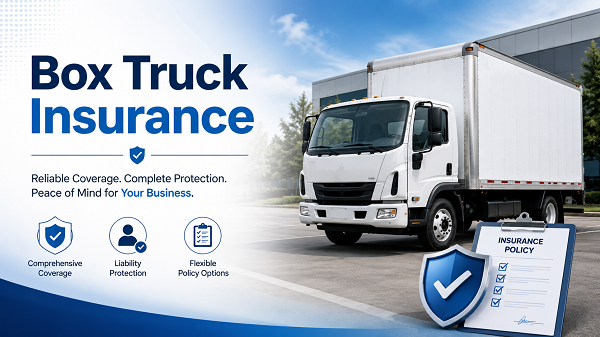
Box trucks are used by many businesses in the United States. Moving companies, delivery services, furniture stores, contractors, and small business owners often use them to carry goods.
But using a box truck for business also brings risk. An accident can cause damage to the truck, cargo, another vehicle, or even people. This is why box truck insurance is important.
Box truck insurance helps protect your truck, driver, cargo, and business. It can also help pay for legal costs and repair bills after a covered accident.
In this guide, you will learn about box truck insurance coverage, cost, requirements, and simple ways to save money.
What Is Box Truck Insurance?
Box truck insurance is a type of commercial vehicle insurance. It is made for trucks used for business work.
A box truck has a closed cargo area behind the driver’s cabin. It is also called:
- Straight truck
- Moving truck
- Delivery truck
- Cube truck
- Cube van
You may need commercial box truck insurance if you use your truck for:
- Local delivery
- Moving services
- Furniture delivery
- Appliance delivery
- Courier work
- Junk removal
- Construction work
- Business transport
A personal auto insurance policy may not cover a truck used for business. That is why businesses usually need commercial insurance.
Who Needs Box Truck Insurance?
You may need box truck insurance if you own, rent, lease, or use a box truck for business.
This insurance is common for:
- Moving companies
- Delivery businesses
- Furniture shops
- Appliance stores
- Contractors
- Wholesalers
- Courier companies
- Independent drivers
- Small business owners
Even if you only use the truck in your local area, you may still need commercial coverage.
What Does Box Truck Insurance Cover?
The right box truck insurance coverage depends on your business, truck, cargo, and driving area.
Here are the main types of coverage.
Box Truck Liability Insurance
Box truck liability insurance helps pay for damage or injury caused to another person.
It usually includes two parts:
Bodily injury liability:
This helps pay medical bills, lost wages, and legal costs if another person is injured in an accident.
Property damage liability:
This helps pay for damage to another car, building, fence, or other property.
Liability insurance does not usually cover damage to your own truck.
Collision Coverage
Collision coverage helps pay for damage to your own truck after an accident.
It may cover damage if your truck:
- Hits another vehicle
- Hits a wall or pole
- Rolls over
- Is damaged in a single-truck accident
If your truck is financed or leased, this coverage may be required.
Comprehensive Coverage
Comprehensive coverage helps protect your truck from damage that is not caused by a road accident.
It may cover:
- Theft
- Fire
- Vandalism
- Hail
- Storm damage
- Falling objects
- Animal damage
Collision and comprehensive coverage are often called physical damage coverage.
Cargo Insurance
Cargo insurance helps protect the goods inside your truck.
It may cover cargo damaged or lost because of:
- An accident
- Theft
- Fire
- Certain loading problems
Cargo insurance is important for delivery companies and moving businesses.
Before buying cargo coverage, check:
- Maximum cargo value
- Deductible
- Theft rules
- Loading and unloading coverage
- High-value item limits
- Cargo exclusions
Cargo insurance is not always included in a normal commercial auto policy.
Uninsured Motorist Coverage
This coverage may help if another driver causes an accident but has no insurance or not enough insurance.
Rules for this coverage may be different in each state.
Hired and Non-Owned Auto Coverage
This coverage may help when your business uses:
- A rented truck
- A borrowed truck
- An employee-owned vehicle
It is useful for businesses that do not own every vehicle they use.
General Liability Insurance
General liability insurance covers some business risks that are not directly related to driving.
For example, it may help if:
- A customer falls at your office
- Your worker damages customer property
- Someone makes a covered business claim
The exact protection depends on the policy.
Is Box Truck Insurance Required in the United States?
Box truck insurance rules are different in each state.
Your insurance needs may depend on:
- Your state
- Truck size and weight
- Type of cargo
- Whether you cross state lines
- Whether you carry goods for other people
- Business contracts
- Federal rules
Some interstate businesses may also need to follow FMCSA insurance rules.
Certain interstate property carriers may need at least $750,000 in liability coverage. Higher limits may apply for dangerous or hazardous cargo.
However, not every box truck needs the same amount of insurance.
Your client, lender, leasing company, or delivery platform may also ask for higher limits.
Before buying a policy, check with:
- Your state insurance department
- FMCSA, if needed
- A licensed insurance agent
- Your lender
- Your delivery platform
- Your business client
How Much Does Box Truck Insurance Cost?
The box truck insurance cost is different for every business.
Many box truck owners may pay around $250 to $1,200 per month. Some may pay less, while others may pay more.
The final price depends on your truck, drivers, business, cargo, and coverage.
A new company may pay more because it has no insurance history.
The commercial box truck insurance cost may also be higher if:
- The truck is large
- The truck is expensive
- Drivers have accidents or tickets
- The business travels long distances
- The cargo is valuable
- The coverage limits are high
- The business has past claims
What Affects Box Truck Insurance Cost?
Here are the main factors.
Driver Record
A clean driving record may help lower the cost.
Speeding tickets, accidents, and license problems may increase the premium.
Driver Experience
Experienced truck drivers may get better rates than new drivers.
Truck Size and Value
A bigger or more expensive truck usually costs more to insure.
Cargo Type
High-value or fragile cargo may increase the cost.
Examples include:
- Electronics
- Furniture
- Medical equipment
- Jewelry
- Expensive machinery
Driving Area
A local delivery truck may cost less than a truck that travels across many states.
Claims History
A business with many past claims may pay more.
Coverage Limits
Higher insurance limits usually cost more.
Deductible
A higher deductible may lower your premium. But you must pay more from your own pocket after a claim.
Choose a deductible your business can afford.
How to Get Box Truck Insurance Quotes
To get accurate box truck insurance quotes, prepare your business and truck details.
You may need:
- Business name
- Business address
- Truck year and model
- Vehicle identification number
- Truck value
- Truck weight
- Driver names
- Driver license details
- Driving history
- Claims history
- Cargo type
- Cargo value
- Driving area
- Annual mileage
- Required coverage limits
Give the same information to every insurer. This makes it easier to compare quotes.
Do not compare only the price.
Also check:
- Liability limits
- Cargo limits
- Deductibles
- Exclusions
- Driver rules
- Driving area limits
- Rental truck coverage
- Claims support
- Roadside help
How to Find Cheap Box Truck Insurance
Finding cheap box truck insurance does not mean buying weak coverage.
A very low-cost policy may not cover your cargo, driver, or delivery area.
Use these simple tips to save money.
Compare Different Insurance Companies
Get quotes from at least three insurers.
Different companies may give different prices for the same truck.
Hire Safe Drivers
Drivers with clean records may help reduce insurance costs.
Keep the Truck in Good Condition
Regular maintenance can lower accident risk.
Check:
- Brakes
- Tires
- Lights
- Steering
- Mirrors
- Safety equipment
Keep records of all repairs and services.
Create Driver Safety Rules
Your business should have simple safety rules.
These may include:
- Always wear a seat belt
- Do not use a phone while driving
- Follow speed limits
- Check the truck before driving
- Report accidents quickly
- Load cargo safely
Ask About Discounts
Some insurers may offer discounts for:
- Safe driving
- Multiple trucks
- Bundled policies
- Continuous insurance
- Telematics
- Full annual payment
Choose the Right Deductible
A higher deductible may lower the monthly cost.
Do not choose a deductible that is too high for your business.
Review Your Policy Every Year
Your business may change.
You may add or remove:
- Drivers
- Trucks
- Routes
- Cargo types
Reviewing your policy can help remove unnecessary costs and find missing coverage.
Common Box Truck Insurance Mistakes
Avoid these mistakes:
- Using personal auto insurance for business
- Buying the cheapest policy without checking coverage
- Choosing only the legal minimum
- Forgetting cargo insurance
- Not listing all drivers
- Giving the wrong driving area
- Ignoring client or platform rules
- Allowing the policy to expire
- Giving incorrect business details
Always give correct information to the insurer. Wrong information may cause problems when you make a claim.
Is Box Truck Insurance Tax-Deductible?
Box truck insurance may be a business expense.
If the truck is used for business, the insurance premium may be tax-deductible in some cases.
Tax rules depend on your business and situation.
Keep all payment records and speak with a tax professional before claiming a deduction.
Frequently Asked Questions
Do I need commercial insurance for a box truck?
Yes, if you use the truck for business, you usually need commercial insurance.
Does box truck insurance cover cargo?
Not always. Cargo insurance is often bought separately.
Can a new business get box truck insurance?
Yes. New businesses can get coverage, but the cost may be higher.
Does liability insurance cover my own truck?
No. Liability coverage usually pays for damage or injury caused to others.
You need collision and comprehensive coverage for your own truck.
Can I insure a rented box truck?
Yes. You may need hired auto coverage and physical damage protection.
Check the rental agreement before using the truck.
Can I get box truck insurance without a CDL?
It may be possible. CDL rules and insurance rules are different.
The need for a CDL depends on truck weight, cargo, and state or federal law.
Final Thoughts
Box truck insurance is important for any business that uses a truck for delivery, moving, or transport work.
The right policy can protect:
- Your truck
- Your drivers
- Your cargo
- Other people
- Your business money
Start with the required liability coverage. Then check whether you also need collision, comprehensive, cargo, general liability, or uninsured motorist coverage.
Compare different insurance quotes and read the policy carefully.
Do not choose a policy only because it is cheap. Choose coverage that protects your real business risks at a price you can manage.