




A serious accident or lawsuit can create a large financial loss for any business. A customer may suffer a major injury at your store, an employee may cause a road accident while driving a company vehicle, or your business may accidentally damage expensive client property.
Your regular business liability insurance may cover these claims, but only up to its policy limit. When an eligible claim is higher than that limit, a business umbrella policy may provide additional protection.
The U.S. Small Business Administration explains that accidents and lawsuits can create unexpected costs that may place a business at financial risk. Having suitable insurance can help a business manage these risks.
This guide explains what business umbrella insurance is, what it may cover, how much it costs, and how to decide whether your business needs it.
What Is a Business Umbrella Policy?
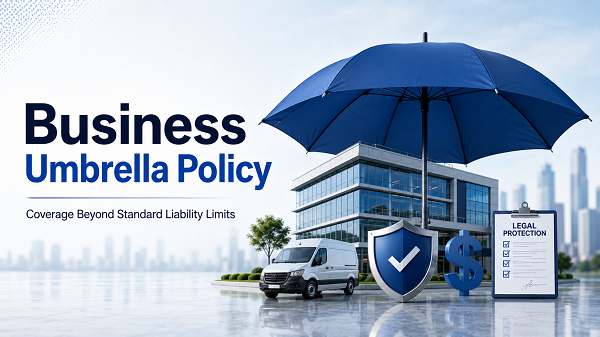
A business umbrella policy is a type of commercial liability insurance that provides additional coverage above certain existing insurance policies.
It normally works over underlying policies such as:
- Commercial general liability insurance
- Commercial auto liability insurance
- Employers’ liability insurance
- Other liability policies specifically listed in the umbrella contract
A business umbrella insurance policy does not replace these policies. It usually starts working only after an eligible underlying policy reaches its coverage limit.
For example, suppose your general liability insurance has a $1 million limit. Your business faces a covered liability claim of $1.5 million.
The general liability policy may pay up to its $1 million limit. If the claim is also covered under the umbrella contract, the umbrella policy may pay part or all of the remaining eligible $500,000.
The actual payment will depend on:
- Policy terms
- Exclusions
- Available limits
- Defense costs
- Required underlying coverage
- Any deductible or self-insured retention
Commercial umbrella insurance is generally designed to provide extra liability limits above general liability, commercial auto liability, and employers’ liability coverage.
How Does Business Umbrella Insurance Work?
Business umbrella insurance works as an extra financial layer.
The process generally looks like this:
- A covered accident or incident occurs.
- A claim is made against the business.
- The primary liability policy responds first.
- The primary policy pays eligible costs up to its limit.
- The umbrella policy may cover eligible costs above that limit.
- Coverage ends when the umbrella limit is fully used.
Here is a simple example.
A company driver causes an accident involving several vehicles. The business is legally responsible for $1.8 million in covered injuries and property damage.
The commercial auto liability policy has a $1 million limit. After that limit is used, an eligible umbrella policy may cover the remaining $800,000.
However, this does not mean every amount above the primary limit is automatically covered. The accident must meet the terms of both the underlying policy and the umbrella policy.
What Does a Business Umbrella Policy Cover?
The exact coverage varies by insurer. However, an umbrella policy for business may provide additional limits for several common liability risks.
Bodily Injury Claims
Bodily injury means physical injury suffered by someone other than the business owner or an employee covered under workers’ compensation.
Examples may include:
- A customer falls and suffers a serious injury at your store.
- A company vehicle causes an accident.
- Business equipment injures a visitor.
- An employee accidentally injures someone while performing work.
A severe injury claim can include medical bills, lost income, rehabilitation expenses, legal fees, settlements, and court judgments.
Third-Party Property Damage
A business may also become responsible for damaging property owned by another person or company.
Examples include:
- A contractor damages a customer’s building.
- A company vehicle damages several parked cars.
- An employee breaks expensive equipment at a client’s location.
- Business operations damage a neighboring property.
Commercial general liability insurance commonly provides primary protection for covered bodily injury, third-party property damage, and certain personal or advertising injury claims.
Commercial Auto Liability
Businesses that own or operate vehicles may face large claims after serious road accidents.
An umbrella liability insurance for business may extend the liability limit of a scheduled commercial auto policy.
It may help with eligible costs related to:
- Injuries to other drivers or passengers
- Damage to other vehicles
- Damage to buildings or public property
- Legal defense costs
- Settlements or judgments
The business must normally maintain the minimum commercial auto liability limit required by the umbrella insurer.
Personal and Advertising Injury
Some policies may provide additional limits for eligible personal and advertising injury claims.
These may involve:
- Libel
- Slander
- Certain privacy violations
- False advertising
- Certain advertising-related copyright claims
Coverage depends on the wording of the underlying and umbrella policies.
Legal Defense Costs
Large liability claims can produce major legal expenses.
Depending on the policy, eligible expenses may include:
- Attorney fees
- Court costs
- Investigation expenses
- Settlements
- Court judgments
Business owners should ask whether defense costs are paid inside or outside the umbrella limit.
If defense costs are inside the limit, money spent on legal fees can reduce the amount available for a settlement or judgment.
What Is Not Covered by a Business Umbrella Policy?
A business umbrella policy does not cover every loss. Common exclusions may include the following.
Damage to Your Own Property
Commercial umbrella insurance generally focuses on liability to other people.
It usually does not pay to repair or replace your own:
- Building
- Office
- Inventory
- Tools
- Equipment
- Furniture
Commercial property insurance is designed for many types of damage to business-owned property.
Professional Mistakes
A consultant, accountant, designer, attorney, or other professional may be sued because of an error, missed deadline, incorrect advice, or failure to provide an expected service.
These claims normally require professional liability or errors and omissions insurance.
A standard business insurance umbrella policy may not automatically extend professional liability coverage unless it is specifically included.
Cyberattacks and Data Breaches
Cyber-related losses are usually not covered by standard commercial umbrella insurance.
Businesses may need separate cyber insurance for risks such as:
- Data breaches
- Ransomware
- Stolen customer information
- Network interruption
- Cyber fraud
- Privacy-related claims
Intentional or Criminal Acts
Insurance generally does not cover losses caused intentionally by the insured.
Fraud, criminal conduct, or deliberate property damage will normally be excluded.
Employee Injuries
Workers’ compensation generally handles covered employee injuries and work-related illnesses.
Employers’ liability is related but different. It may respond to certain employee lawsuits that are not handled as standard workers’ compensation benefits.
An umbrella policy may increase employers’ liability limits when that coverage is specifically listed. However, it does not replace workers’ compensation.
Employment-Related Claims
Claims involving workplace discrimination, harassment, retaliation, or wrongful termination usually require employment practices liability insurance.
Other Possible Exclusions
Depending on the policy, exclusions may also apply to:
- Pollution
- Product recalls
- Contractual liability
- Aircraft
- Watercraft
- War
- Certain high-risk operations
- Punitive damages
- Claims outside the coverage territory
Exclusions vary widely. Business owners should read the actual contract and endorsements instead of relying only on a basic coverage summary.
Business Umbrella Policy vs. General Liability Insurance
General liability and umbrella insurance serve different purposes.
| Feature | General Liability Insurance | Business Umbrella Policy |
|---|---|---|
| Main purpose | Provides primary liability coverage | Provides additional liability limits |
| When it responds | At the start of an eligible claim | Usually after the primary limit is used |
| Common claims | Bodily injury, third-party property damage and advertising injury | Eligible costs above underlying limits |
| Can normally work alone? | Yes | Usually requires underlying coverage |
| Main role | Handles common business liability risks | Helps with severe or unusually large claims |
General liability insurance normally responds first. The umbrella policy may then provide additional coverage if the claim exceeds the general liability limit.
The National Association of Insurance Commissioners explains that general liability coverage in a business policy can protect against claims involving bodily injury, property damage, libel, and slander.
Commercial Umbrella vs. Excess Liability Insurance
Commercial umbrella and excess liability insurance are similar because both can increase a business’s liability protection.
However, they are not always exactly the same.
An excess liability policy commonly follows the conditions and exclusions of one or more underlying policies. Its main purpose is to provide a higher limit.
A commercial umbrella policy may sit over several listed liability policies. Some umbrella forms may also provide limited coverage for certain claims that are not covered by an underlying policy, often after the business pays a self-insured retention.
However, not every umbrella policy provides broader coverage. Some operate mainly as excess coverage.
Insurance companies may also use these product names differently. For this reason, business owners should compare:
- The actual policy form
- Covered underlying policies
- Exclusions
- Coverage territory
- Defense cost rules
- Self-insured retention
- Required primary limits
Triple-I describes excess liability as similar to umbrella coverage because both increase the liability protection provided by a company’s existing insurance policies.
Who May Need a Business Umbrella Policy?
A business may consider umbrella coverage when it has a realistic risk of a claim exceeding its primary insurance limit.
It may be useful for businesses that:
- Regularly interact with customers
- Own or operate commercial vehicles
- Work at customer locations
- Use heavy tools or machinery
- Employ several workers
- Manufacture or sell products
- Handle valuable client property
- Own commercial buildings
- Organize public events
- Sign high-value contracts
- Have large business assets
- Cannot easily pay a major judgment from available funds
Industries that may have higher liability exposure include:
- Construction
- Trucking
- Transportation
- Manufacturing
- Retail
- Restaurants
- Warehousing
- Property management
- Landscaping
- Cleaning services
- Event management
- Delivery services
A small business may also face a large claim. The need for umbrella coverage depends more on the company’s activities and possible losses than on its size alone.
How Much Does a Business Umbrella Policy Cost?
There is no standard price for every business.
The cost of a business umbrella insurance policy depends on the company’s risk level, insurance history, and requested coverage limit.
Insurers may consider:
- Industry
- Business location
- Annual revenue
- Payroll
- Number of employees
- Claims history
- Number of commercial vehicles
- Driver records
- Existing liability limits
- Requested umbrella limit
- Customer traffic
- Work performed away from the business location
- Use of heavy equipment
- Safety practices
- Contract requirements
For example, a small office-based business with no commercial vehicles may have a lower premium than a construction company that operates trucks and heavy machinery.
Umbrella limits are often offered in $1 million increments. Adding $1 million of coverage will generally cost less than adding several million dollars because higher limits create greater potential exposure for the insurer.
In some situations, purchasing umbrella coverage can be less expensive than increasing the limits of several primary policies separately. However, the cost and coverage should be compared carefully.
Avoid choosing a policy based only on the lowest quote. A cheap policy may contain:
- More exclusions
- Lower available limits
- Narrower underlying coverage
- Higher self-insured retention
- Less favorable defense cost terms
How Much Umbrella Coverage Does a Business Need?
There is no single correct limit for every company.
To estimate a suitable amount, consider:
- Total business assets
- Annual revenue
- Number of employees
- Number and type of vehicles
- Possible injury severity
- Customer foot traffic
- Contract requirements
- Previous claims
- Industry risks
- Worksite exposure
- Value of customer property
- Ability to pay uncovered costs
Common limits may start at $1 million and increase to $2 million, $5 million, $10 million, or more.
A company that owns several trucks or works on large construction projects may need more coverage than a home-based administrative business.
The goal is not simply to insure the value of the company’s current assets. Business owners should also consider the size of a realistic lawsuit, including legal costs and future financial damage.
Benefits of a Business Umbrella Policy
Higher Liability Protection
The policy increases the amount available for eligible major claims.
Protection Against Severe Lawsuits
A serious accident may quickly exceed a standard liability limit. Umbrella coverage can reduce the amount the business must pay directly.
Better Protection for Business Assets
Without enough insurance, a large judgment could affect:
- Cash reserves
- Equipment
- Property
- Business income
- Future growth plans
Help Meeting Contract Requirements
Some clients, landlords, lenders, and government contracts require businesses to maintain higher liability limits.
Coverage Over Multiple Policies
A commercial umbrella may provide additional limits over several listed liability policies.
Support as the Business Grows
Insurance needs can change when a business adds employees, vehicles, products, services, or locations.
NAIC notes that a small business may begin with basic coverage and later need to expand its insurance as the company grows.
Requirements for Buying Business Umbrella Insurance
Before providing coverage, an insurer may require the business to:
- Maintain general liability insurance
- Maintain commercial auto insurance when vehicles are used
- Carry minimum underlying liability limits
- Provide claims history
- List business vehicles and drivers
- Describe business activities
- Follow required safety procedures
- Report major changes in operations
If the underlying policy is canceled or reduced below the required limit, the umbrella policy may not pay the gap created by the missing coverage.
For example, if the umbrella policy requires a $1 million general liability limit but the business carries only $500,000, the business may be responsible for the difference.
How to Choose the Right Business Umbrella Policy
Use these steps before purchasing coverage:
- Review your existing liability policies.
- Identify your largest possible claims.
- Check your leases and business contracts.
- Confirm which policies will sit under the umbrella.
- Ask about minimum underlying limits.
- Review all exclusions.
- Check how defense costs are handled.
- Ask whether a self-insured retention applies.
- Compare commercial umbrella and excess liability options.
- Get quotes from more than one insurer.
- Speak with a licensed insurance professional familiar with your industry.
Do not assume two policies with the same limit provide the same protection. Policy wording can be more important than price.
Frequently Asked Questions
What is commercial umbrella insurance?
Commercial umbrella insurance provides additional liability limits above eligible underlying business policies. It may respond when a covered claim exceeds the limit of general liability, commercial auto liability, employers’ liability, or another specifically listed policy.
What is a business umbrella policy?
A business umbrella policy is an additional layer of liability insurance. It may help pay eligible claim costs that are above the limits of a business’s primary liability policies.
What is a business umbrella insurance policy?
A business umbrella insurance policy is commercial coverage that increases the liability limits available to a business. It does not replace primary insurance and only applies according to its own terms, conditions, and exclusions.
Is business umbrella insurance required by law?
Business umbrella insurance is not generally required by federal law for every U.S. business.
However, it may be required by:
- A customer contract
- A commercial lease
- A lender
- A licensing authority
- A government project
- An industry agreement
State and contract requirements should be checked with a licensed professional.
Does an LLC need umbrella insurance?
An LLC may still benefit from umbrella insurance.
An LLC structure may provide some separation between business and personal assets, but it does not prevent lawsuits or pay legal defense costs. The SBA also notes that the protection provided by a business structure has limits.
Does business umbrella insurance cover commercial auto accidents?
It may provide additional limits above a scheduled commercial auto liability policy.
The company must normally maintain the minimum auto liability limit required by the umbrella insurer.
Does umbrella insurance cover professional errors?
Not automatically.
Professional mistakes usually require professional liability or errors and omissions insurance. Umbrella coverage applies only if the professional liability policy is eligible and specifically included.
Can a small business buy umbrella insurance?
Yes. Small businesses can purchase umbrella insurance if they meet the insurer’s eligibility requirements and carry the required underlying coverage.
Is commercial umbrella insurance the same as excess liability insurance?
They are similar, but they are not always identical.
Both provide higher liability limits. Their coverage scope, exclusions, and underlying policy requirements may differ by insurer.
Final Thoughts
A business umbrella policy can provide an extra layer of financial protection when an eligible liability claim exceeds the limit of a primary business insurance policy.
It may help with severe bodily injury claims, third-party property damage, commercial auto accidents, legal costs, settlements, and court judgments. However, it does not replace general liability, commercial auto, workers’ compensation, professional liability, cyber insurance, or other specialized policies.
Before choosing coverage, review your business activities, assets, vehicles, employees, contracts, claims history, and current policy limits. Compare the actual terms and exclusions—not only the premium.
A licensed insurance professional can help you understand the available options and select a limit that fits your company’s real risks.