




A customer might get hurt while visiting your business. You might accidentally damage someone Property.. A client could claim that a mistake in your professional work caused them to lose money.
This is where business insurance can make a difference.
Two types of insurance you will often hear about are liability insurance and professional liability insurance. The names sound similar so it is easy to think they provide the protection. They don’t.
So what is the difference between liability vs professional liability?
The simple answer is:
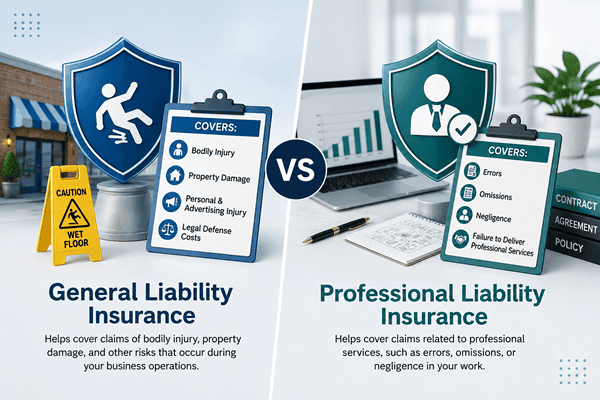
General liability insurance generally helps address third-party claims involving things like bodily injury, property damage and personal or advertising injury. Professional liability insurance generally focuses on claims related to services, such, as alleged mistakes, errors, omissions or negligence.
Lets break it down with some examples.
What Is General Liability Insurance?
Think about what could happen when people interact with your business.
A customer walks into your store and gets injured. A contractor accidentally damages a customer’s property. Someone claims that your business caused certain personal or advertising harm.
These are examples of situations where general liability insurance may be relevant, depending on the circumstances and the policy.
General liability insurance commonly addresses certain claims involving:
- Third-party bodily injury
- Third-party property damage
- Personal injury
- Advertising injury
- Certain legal defense costs
For example, imagine you own a small clothing store.
A customer comes into your store and has an accident. They believe your business was responsible and make a claim for their injury.
That is very different from a client saying, “Your professional advice caused me to lose money.” The first situation may involve general liability, while the second may involve professional liability.
Of course, whether a particular claim is covered always depends on the actual insurance policy.
What Does “Personal Injury” Mean Here?
There is one insurance term that can be confusing: personal injury.
In everyday conversation, people usually hear “personal injury” and think about physical injuries.
In general liability insurance, however, the term can refer to certain non-physical injuries, such as specific claims involving privacy, reputation, or other situations defined by the policy.
That is different from bodily injury, which generally refers to physical injury, sickness, or disease.
Because insurance companies can define these terms differently, it is always a good idea to check the definitions in your actual policy.
What Is Professional Liability Insurance?
Now let’s look at the other side.
Professional liability insurance is generally about the work, advice, knowledge, or services you provide to your clients.
Suppose a client hires you because they trust your professional expertise. Later, the client believes you made an error or failed to provide the service properly and says that the mistake caused them a financial loss.
That is the kind of situation where professional liability insurance may become important.
Professional liability can be relevant to people and businesses such as:
- Consultants
- Accountants
- IT professionals
- Designers
- Engineers
- Architects
- Marketing professionals
- Technology consultants
- Other professional service providers
You may also hear professional liability described as errors and omissions (E&O) insurance. The terminology can vary depending on the profession, insurer, and policy.
A Simple Example
Let’s say you run an IT consulting business.
A company hires you to provide professional IT services. Later, the client claims that an error in your work caused them a financial loss.
This isn’t primarily about someone slipping in your office or you damaging someone’s property.
The complaint is about the professional service you provided.
That’s why professional liability may be relevant.
General Liability vs Professional Liability: What’s the Real Difference?
Here’s an easy way to remember it:
General liability is generally about certain risks connected to your business operations.
Professional liability is generally about claims connected to the professional services you provide.
For example:
| Situation | Type of Liability That May Be Relevant |
|---|---|
| A customer is injured at your business | General liability |
| Your business damages a customer’s property | General liability |
| A client claims your professional advice caused a financial loss | Professional liability |
| A client alleges an error in your professional work | Professional liability |
| A client claims you made an omission while providing professional services | Professional liability |
This doesn’t mean every claim automatically falls into one category. Insurance policies have specific definitions, exclusions, conditions, and limits.
But this basic distinction makes the two types of insurance much easier to understand.
A Real-Life Style Example
Let’s say you own a small web design company.
You might think, “I’m just designing websites. Why would I need liability insurance?”
Here’s why.
Example 1: A General Liability Situation
A client visits your office for a meeting and gets physically injured.
That’s a business-operation risk. General liability insurance may be relevant, depending on the circumstances and your policy.
Example 2: A Professional Liability Situation
You build a website for a client. Later, the client says that an error in your professional work caused them financial harm.
Now the issue is related to the service you provided.
That’s where professional liability may be relevant.
Same business. Two completely different risks.
That’s the easiest way to understand why businesses sometimes consider both types of coverage.
Who Should Consider General Liability Insurance?
General liability can be useful for many types of businesses because almost any business can interact with customers, visitors, vendors, or other third parties.
Businesses that may consider general liability include:
- Retail stores
- Restaurants
- Contractors
- Construction companies
- Cleaning businesses
- Salons
- Repair businesses
- Manufacturers
- Event businesses
- E-commerce businesses
- Local service businesses
The important thing is that there is no one-size-fits-all answer.
A restaurant has different risks from an online consultant. A contractor has different risks from a graphic designer.
Your insurance should make sense for what your business actually does.
Who Should Consider Professional Liability Insurance?
Professional liability can be especially important for businesses where clients depend on their knowledge, expertise, advice, designs, or specialized services.
For example:
- Consultants
- Accountants
- IT consultants
- Software professionals
- Architects
- Engineers
- Designers
- Marketing agencies
- Financial professionals
- Other professional service businesses
If a mistake in your professional work could potentially cause a client financial harm, professional liability may be worth considering.
Do You Need Both General Liability and Professional Liability?
This is one of the most common questions business owners ask.
And the answer is: it depends on your business.
Some businesses may have risks that fit mainly under general liability. Others may have professional-service risks. Some businesses can face both.
For example, imagine an IT consulting company with an office.
A visitor could get injured at the office. That’s one type of risk.
A client could also claim that the company’s professional IT work caused financial damage. That’s a different type of risk.
Having general liability does not automatically mean you have professional liability coverage.
Likewise, having professional liability does not automatically mean you have general liability coverage.
That’s why it’s important to look at the actual coverage rather than assuming one policy covers everything.
What Does General Liability Usually Not Cover?
General liability is not a “cover everything” policy.
For example, you should not automatically assume that general liability covers:
- Professional mistakes
- Every type of financial loss
- Employee work-related injuries
- Intentional acts
- Every contractual dispute
- Every type of business loss
There can also be other exclusions depending on the policy.
That’s why reading the policy is important.
What Does Professional Liability Usually Not Cover?
Professional liability has limits too.
It is generally designed around claims involving professional services. It isn’t meant to replace every other type of business insurance.
Depending on the policy, you should not automatically assume it covers:
- Every bodily injury claim
- Every property damage claim
- Intentional wrongdoing
- Every contractual dispute
- Risks specifically excluded by the policy
Again, the actual policy language matters.
What About Workers’ Compensation?
Workers’ compensation is another type of insurance that business owners sometimes confuse with general liability.
They are not the same.
Here’s a simple example:
A customer gets injured at your business:
General liability may be relevant.
A client claims your professional service caused them a financial loss:
Professional liability may be relevant.
An employee suffers a work-related injury:
Workers’ compensation may be relevant, depending on the circumstances and applicable state requirements.
Workers’ compensation rules vary across the United States, so business owners should check the requirements that apply in their state and situation.
How Much Does Liability Insurance Cost?
There isn’t one price that applies to every business.
Insurance companies may look at things such as:
- Your industry
- Type of business
- Location
- Annual revenue
- Number of employees
- Claims history
- Services you provide
- Coverage limits
- Deductible
- Overall business risk
For example, a freelance consultant and a construction company can have very different insurance needs.
So instead of asking only, “What’s the cheapest policy?”, a better question is:
“Does this policy provide the coverage my business actually needs?”
Price matters, but coverage matters too.
How Do You Choose the Right Coverage?
If you’re buying business insurance for the first time, it can feel confusing.
You don’t need to understand every insurance term immediately. Start with your business and work from there.
Step 1: Look at What You Actually Do
Ask yourself:
- What products or services do I provide?
- Do customers visit my business?
- Do I visit customer locations?
- Do I provide advice?
- Do clients depend on my professional expertise?
- Could a mistake in my work cause a client financial loss?
- Do I handle other people’s property?
Your answers can help identify your main risks.
Step 2: Think About What Could Go Wrong
Don’t just think about your normal day.
Think about the things that could cause a serious problem.
For a restaurant, a customer injury may be an important concern.
For a consultant, a professional-service error may be a bigger concern.
For a contractor, both property damage and other business risks may matter.
Step 3: Check Your Contracts
Some clients, landlords, or business partners may require you to carry certain insurance.
Before purchasing a policy, check your contracts carefully.
Step 4: Look at the Coverage Limits
Don’t just look at the premium.
Look at how much coverage the policy provides and whether the limits make sense for your business and contractual requirements.
Step 5: Read the Exclusions
This step is easy to skip, but it matters.
A policy tells you what it covers, but it also tells you what it does not cover.
Understanding those exclusions can help prevent unpleasant surprises later.
Step 6: Ask a Licensed Insurance Professional
If you’re still unsure, talk to a licensed insurance agent or broker who understands your industry and state.
They can help you evaluate your specific situation.
Common Mistakes Business Owners Make
Even experienced business owners can misunderstand liability insurance.
Here are a few common mistakes to avoid.
Assuming One Policy Covers Everything
General liability and professional liability have different purposes.
Don’t assume that one automatically replaces the other.
Choosing Only the Cheapest Policy
A low price doesn’t necessarily mean the policy is the right fit for your business.
Look at coverage, limits, exclusions, and deductibles too.
Ignoring Exclusions
The exclusions section can be just as important as the coverage section.
Read it carefully.
Forgetting About Contract Requirements
A client or landlord may require specific insurance or coverage limits.
Make sure you understand those requirements before signing a contract.
Never Reviewing Your Insurance
Businesses change.
You might add employees, offer new services, move locations, or start working with larger clients.
When your business changes, it’s a good idea to review your insurance needs as well.
Frequently Asked Questions
Is general liability the same as professional liability?
No.
General liability generally focuses on certain third-party risks such as bodily injury, property damage, and personal or advertising injury.
Professional liability generally focuses on claims related to professional services, such as alleged errors, omissions, or negligence.
Which is better: general liability or professional liability?
Neither one is automatically better.
They are designed for different risks.
The right coverage depends on what your business does and the risks it faces.
Does general liability cover professional mistakes?
Generally, professional mistakes are not the main purpose of general liability insurance.
Professional liability is generally designed to address claims related to professional services, subject to the policy terms and exclusions.
Is professional liability the same as E&O insurance?
They are often closely related terms.
Errors and omissions, or E&O, insurance is commonly used to describe coverage for certain claims involving professional services. However, terminology and coverage can vary by profession and insurer.
Does general liability cover employee injuries?
General liability should not be treated as a replacement for workers’ compensation.
Workers’ compensation requirements vary by state and depend on factors such as the business and its employees.
Can a small business have both types of insurance?
Yes.
A business can have both general liability and professional liability if its operations create both types of risks.
How much liability insurance does a small business need?
There isn’t one answer for every business.
The amount of coverage that makes sense can depend on your industry, location, contracts, business size, services, and potential risks.
General Liability vs Professional Liability: Final Thoughts
So, general liability vs professional liability — which one do you need?
It really comes down to the kind of work your business does.
General liability insurance generally focuses on certain third-party claims involving bodily injury, property damage, and personal or advertising injury.
Professional liability insurance generally focuses on claims related to professional services, including alleged errors, omissions, or negligence.
And for some businesses, the answer isn’t one or the other. Both may be relevant.
The best place to start is by looking honestly at your business.
What do you do? Who do you work with? What could go wrong? What does your client contract require?
Once you understand those risks, you can make a much more informed insurance decision.
If you’re unsure, a licensed insurance professional can help you understand what types of coverage may fit your business and state.