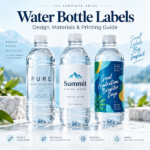




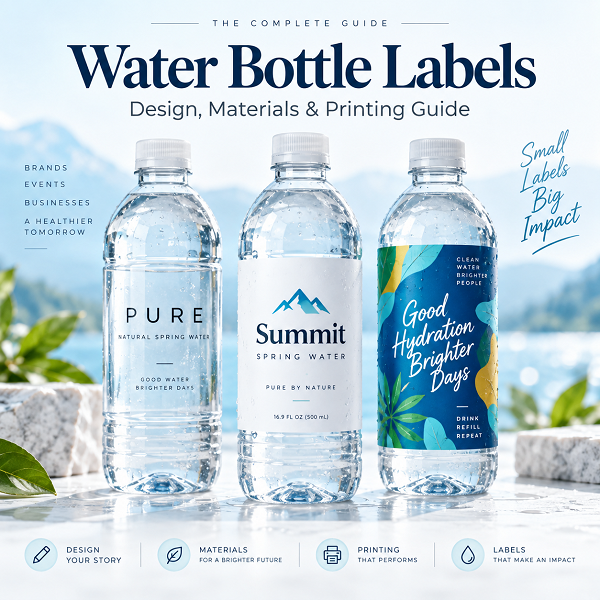
Water Bottle Labels: Design, Materials & Printing Guide
Water bottle labels can turn an ordinary bottle into a branded product, event detail, promotional giveaway, or personalized keepsake. But a good label needs to do more than look attractive. It has to fit the bottle, stay readable, stick properly, and handle the conditions in which the bottle will be used.
For chilled bottles, moisture resistance matters. For business branding, logo visibility and print quality matter. For high-volume orders, label format and application speed can make a big difference.
This guide explains how to choose, design, and print water bottle labels for businesses, events, hospitality, promotions, and personal use in the U.S.
What Are Water Bottle Labels?
Water bottle labels are adhesive printed labels or wraps used for branding, personalization, product information, or event decoration. They may be made from paper, plastic film, clear material, or weather-resistant stock and can be supplied on sheets, rolls, or as individually cut labels.
The best option depends on the bottle surface, moisture exposure, quantity, design, and how the labels will be applied.
If bottles will be refrigerated or placed in ice, a moisture-resistant material is generally a better choice than standard paper. Current U.S. label suppliers offer weatherproof polyester, BOPP films, waterproof plastics, and other materials specifically intended for more demanding applications.
What Makes a Good Water Bottle Label?
A successful label balances design with practical performance.
Before ordering custom water bottle labels, consider:
- Bottle size and shape
- Refrigeration and condensation
- Label material
- Adhesive
- Full-wrap or front-only design
- Quantity
- Manual or machine application
- Required product information
- Print finish
- Budget
The most attractive design will not help if the label wrinkles around a curved bottle or starts lifting after the bottle becomes cold.
Start with the bottle and its environment, then build the design around those requirements.
Best Materials for Water Bottle Labels
There is no single best material for every application.
Waterproof or Weather-Resistant Film
Film-based labels are usually the stronger option when bottles will be:
- Refrigerated
- Placed in coolers
- Exposed to condensation
- Used outdoors
- Handled with wet hands
BOPP is a common film option in professional label printing. UPrinting currently offers white, clear, metallic, and removable BOPP options, while SheetLabels lists weatherproof materials for both sheets and rolls.
For cold bottled water, ask the printer whether both the face material and adhesive are suitable for moisture. Water resistance is not only about the printed surface; the label also needs to stay attached.
White Film Labels
White film creates an opaque background behind the artwork.
It works well for:
- Bright brand colors
- Detailed logos
- Dark or transparent bottles
- High-contrast text
- Corporate branding
Because the bottle color does not show through as strongly, white material can make artwork easier to control visually.
Clear Water Bottle Labels
Clear water bottle labels create a clean, minimal look and allow the bottle to remain visible behind the design.
They are especially suitable for:
- Premium branding
- Hotels
- Wellness companies
- Minimalist designs
- Transparent bottles
One important detail is white ink.
On a transparent label, areas that look white in the artwork may become transparent unless the printing process includes white ink. Some professional printers allow white ink to be added to clear-label designs.
If bright whites or opaque colors matter to your design, ask the printer how white ink is handled before approving the artwork.
Paper Labels
Paper labels can work well for dry, short-duration applications such as:
- Indoor parties
- Weddings
- DIY projects
- Room-temperature bottles
- Small promotional events
They can also provide a softer or more natural appearance.
For bottles that will be refrigerated, however, check the material specifications carefully before choosing ordinary paper.
How to Choose the Right Water Bottle Label Size
There is no universal water bottle label size.
Two bottles that both hold 16 oz or 500 mL can still have different shapes, curves, and printable areas.
Professional printers themselves recommend measuring the actual bottle rather than relying only on its capacity. UPrinting, for example, notes that bottle dimensions vary between manufacturers.
Measure These Areas
Before creating your water bottle label design, measure:
- Height of the smooth label area
- Circumference of the bottle
- Curved or tapered areas
- Space available for a front-only label
- Space required for a wraparound design
Then decide what type of label you need.
Full-Wrap Label
A full-wrap label covers most or all of the bottle circumference.
Best for:
Strong branding, product presentation, events, and designs containing more information.
Front-Only Label
A smaller label is placed on the visible front area.
Best for:
Logos, QR codes, names, short messages, and simple branding.
Square or Custom-Shaped Label
A square water bottle label design or die-cut sticker can work well for promotional branding, but check the bottle curvature first. Large square corners may be harder to apply cleanly on a strongly curved surface.
Try a Paper Mockup
Before printing, cut ordinary paper to the planned dimensions and place it on the real bottle.
This is one of the easiest ways to catch sizing problems early.
Water Bottle Label Design Tips
A strong label should be easy to understand in just a few seconds.
Make One Element Dominant
Decide what the viewer should notice first.
For a business:
- Logo
- Brand name
- Website
- QR code
For an event:
- Name
- Date
- Monogram
- Short message
Avoid making every element the same size.
Use Readable Typography
Small decorative fonts often look good on screen but become difficult to read once printed and wrapped around a bottle.
Use clear typography and enough contrast between the text and background.
Build a Simple Hierarchy
For example:
Brand Name
Event or Product Name
Short Supporting Message
Website or QR Code
This keeps the design easy to scan.
Keep Important Content Away From the Edges
Do not position logos, names, or QR codes too close to the trim line.
Allow enough safe space so minor cutting or application variation does not affect important information.
Use High-Resolution Artwork
A low-resolution logo may look acceptable on a phone but appear blurry in print.
Follow your printer’s artwork specifications for:
- Resolution
- Bleed
- File type
- Color setup
- Safe area
Design for a Curved Surface
A flat design file does not show exactly what someone will see after the label wraps around a bottle.
Place the most important content in the area that will face forward.
Are Water Bottle Stickers and Water Bottle Labels the Same?
The terms water bottle stickers and water bottle labels often overlap.
Generally, “label” is more commonly associated with packaging, identification, or product information, while “sticker” may be used more broadly for branding and decoration.
But the name matters less than the specifications.
Compare:
| Feature | Bottle Labels | Bottle Stickers |
|---|---|---|
| Common use | Packaging and product branding | Promotion and decoration |
| Typical shape | Rectangle or wrap | Any shape |
| Format | Sheets or rolls | Sheets, rolls, or singles |
| Application | Manual or automated | Usually manual |
| Key consideration | Fit and labeling function | Visual branding |
A printer may use either term for nearly the same adhesive product.
When comparing water bottle sticker printing, focus on material, adhesive, size, finish, and durability instead of the wording alone.
Sheet Labels vs. Roll Labels
The right format depends mostly on order quantity and application method.
Sheet Labels Are Useful When:
- You need smaller quantities
- Labels will be applied manually
- You have several designs
- You may print some labels yourself
Roll Labels Are Useful When:
- You need larger quantities
- Labels must be applied quickly
- You use a dispenser
- Labels will be machine-applied
Current suppliers offer water bottle labels on sheets, rolls, and individually cut formats. SheetLabels, for example, supports all three.
If labels will be used with an automated applicator, ask the printer about roll direction, core size, and spacing before production.
How Water Bottle Label Printing Works
Professional water bottle label printing usually follows these steps.
1. Measure the Bottle
Identify the exact area available for the label.
2. Choose the Material
Base the decision on moisture, appearance, bottle surface, durability, and cost.
3. Create the Design
You can:
- Upload finished artwork
- Use an online water bottle label maker
- Customize a template
- Work with a designer
Many U.S. printers currently offer templates and online design tools for custom labels.
4. Select the Size and Shape
Choose a standard size or custom dimensions based on the bottle.
5. Choose Sheets, Rolls, or Singles
Match the format to the quantity and application method.
6. Review the Proof
Check:
- Spelling
- Dimensions
- Logo quality
- Colors
- QR codes
- Contact information
- Bleed
- Alignment
7. Test Before a Large Order
If possible, apply a sample to the real bottle.
For chilled bottles, perform a simple cold-bottle test: refrigerate a labeled bottle, allow condensation to develop, and check whether the label lifts, wrinkles, smears, or loses adhesion.
That small test can prevent a large production mistake.
How Much Does Water Bottle Label Printing Cost?
There is no universal water bottle label printing cost.
Pricing changes based on specifications rather than the keyword “water bottle label.”
The biggest factors usually include:
| Factor | How It Can Affect Cost |
|---|---|
| Quantity | Larger runs often reduce unit cost |
| Material | Weather-resistant films may cost more than basic paper |
| Size | Larger labels use more material |
| Custom shape | Die-cut or specialty shapes may add cost |
| Finish | Specialty coatings or effects can increase price |
| Format | Sheets, rolls, and singles may be priced differently |
| Multiple designs | Can affect setup or production depending on printer |
| Turnaround | Rush production may cost more |
Current U.S. printers allow customers to configure price by material, size, quantity, and format, which shows why comparing only a headline price can be misleading.
Compare Quotes Properly
When comparing two printers, use the same:
- Size
- Quantity
- Material
- Finish
- Shape
- Delivery requirements
Otherwise, the cheaper quote may simply be for a different product.
Also consider the cost per usable label. A cheaper paper label that fails after refrigeration may offer worse value than a slightly more expensive moisture-resistant label.
Best Uses for Custom Water Bottle Labels
Corporate Events
Add a logo, QR code, or campaign message for:
- Conferences
- Trade shows
- Seminars
- Product launches
- Business meetings
Weddings and Parties
Personalized labels can include:
- Names
- Event date
- Monograms
- Thank-you messages
- Custom themes
Hotels and Hospitality
Branded bottles can be used in:
- Guest rooms
- Conference rooms
- Reception areas
- Welcome kits
Gyms and Wellness Brands
Water bottle branding stickers can keep a logo visible during fitness classes, races, wellness events, and promotional campaigns.
Real Estate and Local Promotions
Custom bottles can be distributed at:
- Open houses
- Community events
- Brand activations
- Outdoor promotions
Water bottle label suppliers currently market templates and products for businesses, weddings, birthdays, graduations, and other personalized uses.
How to Apply Water Bottle Labels Without Bubbles or Peeling
For cleaner application:
- Start with a clean bottle.
- Make sure the surface is completely dry.
- Remove old adhesive if necessary.
- Align one edge before pressing down.
- Apply slowly across the bottle.
- Smooth outward to reduce trapped air.
- Avoid stretching the label.
- Follow the supplier’s recommended bonding instructions.
For large commercial runs, consider whether roll labels and an application tool would save time compared with applying individual stickers by hand.
Common Water Bottle Label Mistakes
Choosing Material Based Only on Price
A cheaper stock may not suit refrigerated bottles.
Guessing the Size
Measure the real bottle instead of assuming all bottles of the same volume are identical.
Ignoring Adhesive Performance
A waterproof face material is not useful if the adhesive does not perform well in the intended environment.
Using Too Much Text
A bottle label is not a brochure.
Keep the message focused.
Poor Clear-Label Design
Transparent labels may require white ink or stronger contrast to make the design visible.
Ignoring Bottle Curvature
Strong curves can cause larger labels to wrinkle or lift.
Skipping a Physical Test
A sample can reveal problems with size, adhesion, readability, and color before bulk production.
Important U.S. Labeling Note for Commercial Bottled Water
A decorative event label and a label for bottled water sold commercially are not the same thing.
In the United States, bottled drinking water is subject to federal food regulations. FDA regulatory resources reference 21 CFR Part 129 for processing and bottling and 21 CFR 165.110 for bottled water standards.
If you manufacture or sell bottled water commercially, do not treat a creative bottle sticker design as a substitute for required product information.
Before production, verify:
- Current FDA requirements
- Applicable state requirements
- Product identity
- Required statements or disclosures
- Business-specific labeling obligations
For regulated products, compliance should be checked before printing thousands of labels.
FAQs About Water Bottle Labels
Are water bottle labels waterproof?
Not all of them. Paper may be suitable for dry environments, while weather-resistant polyester, BOPP, and other plastic films are available for bottles exposed to moisture. Check both the material and adhesive specifications when the bottle will be chilled.
What size should a water bottle label be?
There is no single standard size that fits every bottle. Measure the smooth labeling area of the actual bottle, including its height and circumference, before designing. Bottle dimensions can vary even when the fluid capacity is the same.
What material is best for refrigerated water bottles?
A moisture-resistant plastic film such as an appropriate BOPP or weatherproof polyester is often a better choice than ordinary paper. Confirm that the adhesive is also suitable for refrigeration and condensation.
Can I design my own water bottle labels?
Yes. You can create artwork yourself, use an online water bottle label design tool, customize a printer template, or hire a designer. Always follow the printer’s artwork and bleed specifications before submitting the final file.
How much does water bottle label printing cost?
Cost depends on size, material, quantity, shape, finish, print format, turnaround, and supplier. For a useful comparison, request quotes using identical specifications rather than comparing prices for different materials or quantities.
Are sheet or roll labels better?
Sheets are convenient for smaller manual jobs. Rolls are usually more practical for larger orders, dispensers, or automated application. Neither format is universally better; the right choice depends on quantity and workflow.